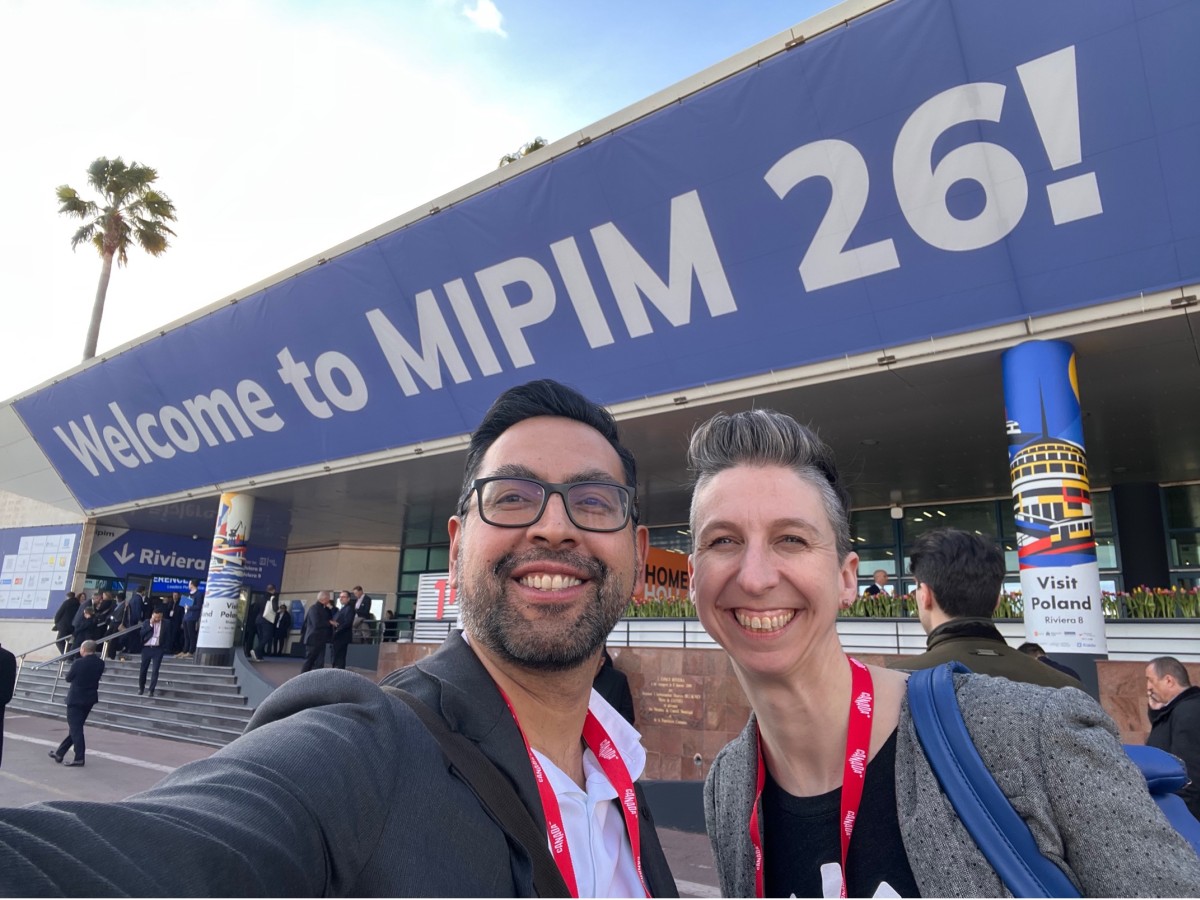
Each year, investors and developers come together in Cannes, France to attend MIPIM – one of the world’s leading real estate events — where the competition to attract money and attention of investors is fierce. This festival brings global leaders together who share investment strategies and grow partnerships through networking, workshops and discussions.
This year, Winnipeg Economic Development & Tourism’s Alberto Velasco-Acosta, vice president, International, and Natalie Thiesen, vice-president, Tourism, attended to showcase Winnipeg and its potential not only as an ideal location for foreign direct investment and expansion in traditional sectors like aerospace, advanced manufacturing and transportation & distribution, but as an up-and-coming destination for tourism development.
For 2026, Destination Canada hosted a “Team Canada” delegation, including partners from Vancouver, Winnipeg and Toronto, to represent Canada’s tourism investment opportunities. Investors and capital fund holders were introduced to possibilities within Canada’s tourism sector, like hotels and resorts, attractions and mixed-use facilities.
Velasco-Acosta and Thiesen both represented Winnipeg on this global stage to show what our city has to offer. MIPIM was the perfect opportunity to leverage our organization's full mandate, which includes foreign direct investment and tourism attraction. This will strengthen Winnipeg’s overall global competitiveness as a single agency.
***
What was your goal in attending MIPIM?
AVA: The goal in attending MIPIM was to be part of this new initiative that Destination Canada is building in destination development. We want to bring investments to our tourism sector in Canada, so we can grow our supply of tourism related offerings, including convention centres, mixed-use projects and hotels that can enhance the tourism attractability and competitiveness of the city.
NT: The goal of attending MIPIM was two-fold. From a tourism perspective, it was really to understand the ecosystem for investment. It's well known in Canada that the tourism sector lacks investment in terms of opportunities for growth, whether it's building new resorts, hotels or accessing capital for tourism infrastructure. Part of the opportunity was to travel with Destination Canada and to organize ourselves as a country. We wanted to elevate the profile and size of the [tourism] sector — its growth opportunities. Its strength in Canada, its contribution to the economy, including number of jobs, and the various environments in which it operates.
How does Winnipeg compare on a global stage? What are its assets?
AVA: In this case, European funds are looking to diversify their portfolios and that means looking at non-European jurisdictions and opportunities within Canada. Obviously, we think Canada is a beautiful opportunity, and Winnipeg is an opportunity to double diversify the market. We all know, when people think of Canada, they stay in the Montreal, Toronto, Vancouver regions and diversifying those larger cities requires an extra step. Because Winnipeg is a city not tapped by a large set of competitors from the European market, they can take advantage of what Winnipeg has to offer. We have space — with CentrePort Canada’s 20,000 acres of land being just one clear example of these advantages. Not only do we provide renewable and clean energy, it is also affordable and sustainable.
NT: We have a unique value proposition in Canada and in Winnipeg. Our market is not saturated and we have the opportunity to be intentional within the community, and to determine which tourism projects are the best fit to address a gap in the sector.
From a tourism perspective, Winnipeg has a strong visitor base, which gives us an opportunity to grow and explore other options for tourism investment.
Winnipeg EDT continues to transition into a one-agency model, allowing us to work together to leverage our full capacity in markets like MIPIM. What were some of your takeaways?
AVA: Winnipeg EDT's team has been working in the tourism sector for many, many years and they're good at what they do. But within the one-agency model, [I have to figure out] how do I use the processes, networks and the team that already exists and take it to a market like MIPIM? And I think it's fascinating. There aren’t many in Canada who can say they can do that right now. Out of the eight markets that went to MIPIM, they each had to bring their economic development partner.
NT: When Alberto was talking about some of the policy realities and opportunities in Winnipeg, I could speak to the growth signals in terms of visitation. This could be done in tandem, which sounds simple, but it’s much more complicated when the lines of communication aren’t open. We also planned [for MIPIM] together, and the idea of co-pitching is done much more authentically when there's a foundational understanding of each other's work, and of the work the team does in market. It can be seen and it actually materializes for a client or an investor who’s interested in coming here.
What were your takeaways from MIPIM?
AVA: This is a long-term play, because every time I go there, it's a reminder of how big the gap is between where I am today and where I think we should be as a community. We need to be seen, to be heard, [in order] to be attractive and to have people start asking for us. That would be ideal, right? Like, okay, Canada is here, but where's the Winnipeg people? I want to see what's new in Winnipeg, because I got this much money, and I'm over-leveraged here and over-invested in this region. I want to see what Winnipeg is. That would be ideal. It was a great opportunity to expand and diversify the markets we have been so dependent on. And MIPIM was a great platform to connect with those diversified markets.
NT: I think there's proof in this [one-agency] model, that has already been proven in Europe. We were invited to sit at a round table with a group of cities of similar size to Winnipeg. There was Stockholm, Greater Manchester, other European cities, Toronto and ourselves. We discussed how several European cities have the same model as us, and how they leverage this model from a competitive advantage. You see this level of sophistication and it validates the journey we're on. In Canada, we're leading the way and we are being called upon by other jurisdictions to share our experience.
***
This interview has been edited for length and clarity.
