
The implementation of Section 338 tariffs against Canadian exports to the U.S. was an unprovoked escalation in trade tensions between the two countries. This served as a stark reminder that Canada, including Manitoba, must diversify its trade partners.
To put the diversification goal into perspective, Manitoba shipped roughly $20 billion worth of goods to the world in 2025, of which nearly $13 billion went to the U.S. If we hold exports to the U.S. constant at its 2025 level, Manitoba will need to double its exports to the rest of the world just to achieve 50/50 parity between the latter and former.
This Digest decomposes Manitoba’s exports from 2023 to present (August 2026) by country, goods category and region. It examines opportunities to increase exports to Europe and the potential for the Port of Churchill to expand trade with Europe, Africa and South America.
Merchandise exports in detail
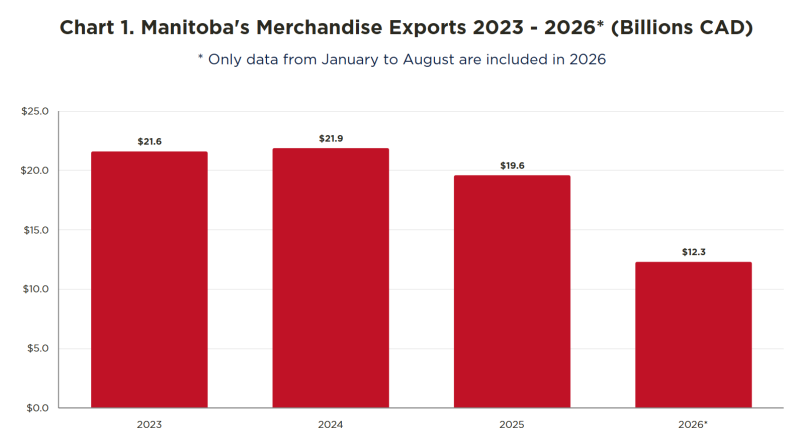
Between 2023 and August 2026 Manitoba exported $75.5 billion worth in merchandise exports to the world (see chart 1). There was a decline in total merchandise exports between 2024 and 2025. That is due in part to the ongoing trade war with the U.S., trade tensions with China that were resolved earlier this year, and the drought which drastically lowered Manitoba Hydro’s exports of electrical energy to the U.S. For the record, Manitoba tends to export and import more interprovincially than it does internationally. From 2020 – 2024, 52.8 per cent of its total trade was interprovincial compared to 47.2 per cent international.
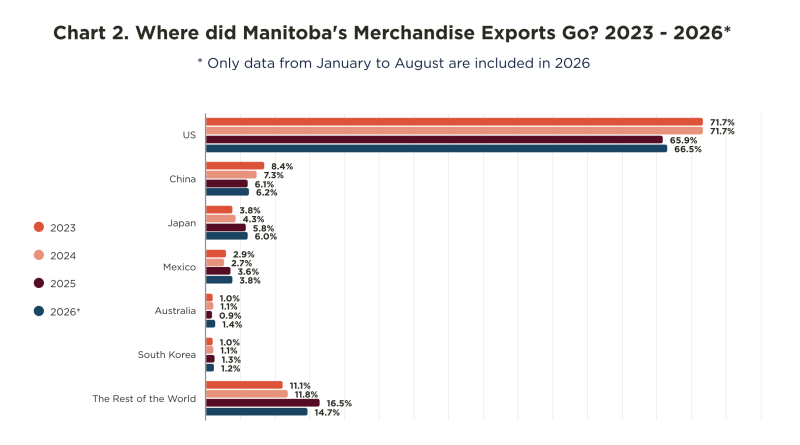
Prior to the most recent trade war, the U.S. purchased 71.7 per cent of Manitoba’s exports (see chart 2). Since then, they have been purchasing between 65.9 – 66.5 per cent. Compared to Jan – Aug of 2025, exports to the U.S. are nearly $1 billion lower this year, most likely due to the Section 338 tariffs. Except for China, which imposed tariffs of its own against Canadian agricultural products, and Australia, exports to the rest of the world either remained stable or increased in both share and value (the export share to the rest of the world for 2026 may be higher when the full-year data is available). Exports to Japan, Mexico and South Korea accounted for just over 10 per cent of Manitoba’s total in both 2025 and 2026. These three countries, plus Australia and China, make up the second tier of buyers of Manitoba products and collectively purchased 17.4 per cent of its exports between 2023 and August 2026. This is well below the 69.3 per cent purchased by the U.S. over the same period but significantly more than the 13.3 per cent purchased by the rest of the world.
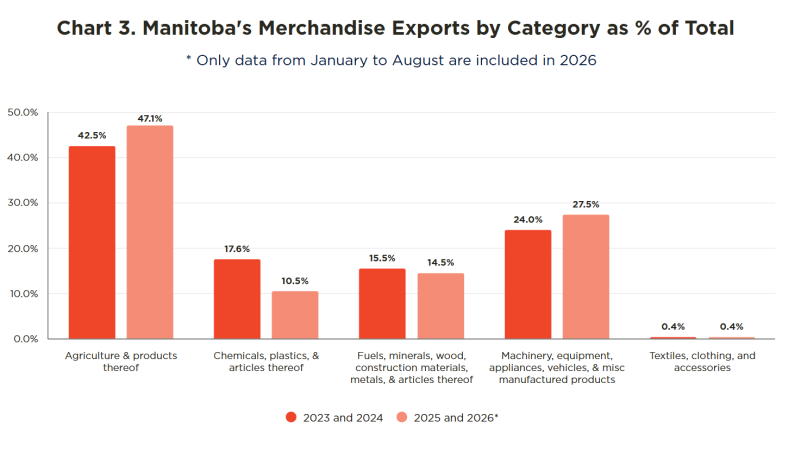
Export destinations are only one measure of the diversification effort: what we export matters too. Chart 3 shows the share of Manitoba’s export categories, separately for 2023 – 2024 and 2025 – August 2026, based on the Harmonized System two-digit export classification codes (HS2) used by Statistics Canada. Manitoba’s exports are more diverse by category than destination. Agriculture and related products account for the largest share at 42.5 – 47.1 per cent, followed by a broad set of manufacturing products at 24 – 27.5 per cent, then natural resources (hydroelectricity is a fuel) at 14.5 – 15.5 per cent, chemicals and plastics at 10.5 – 17.6 per cent, and textiles, clothing, and accessories the outlier at 0.4 per cent. However, when we look at these categories by destination there is a clear lack of diversity.
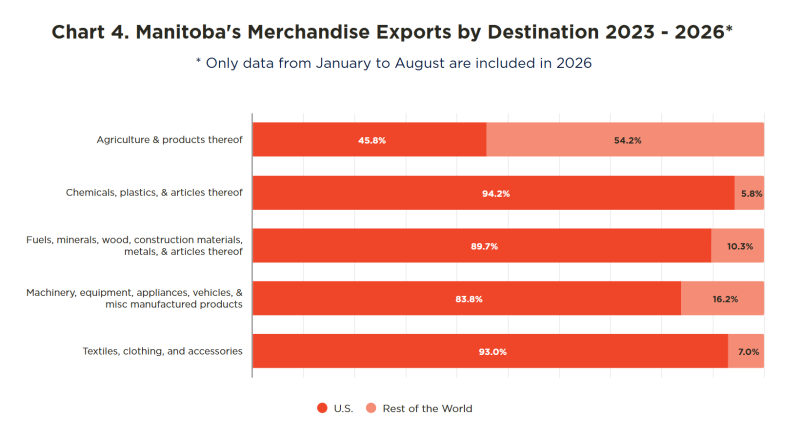
The share of each category going to the U.S. or the rest of the world demonstrates that only agricultural products are global (see chart 4). Agricultural products are more generalized and consumed by every country in the world. On the other hand, manufactured products and hydroelectric energy (fuel) depend on the integrated supply chains or an interconnected electricity grid that exists between Manitoba and the U.S. These connections don't exist, or exist at a much smaller scale, between Manitoba and the rest of the world. A large share of manufactured products, such as aerospace parts, are designed for one specific purpose with limited or no alternatives. Chemicals, plastics, wood, metals, critical minerals and other materials are less diversified by destination than manufactured goods. This is a bit surprising because these items are used further upstream in production and, in theory, should have a wider range of applications and therefore a larger customer base, much like agriculture.
Notice that the changes in export shares shown in chart 3 coincide with how much of that category is bought by the U.S.: if the U.S. bought the majority of the category (upstream products) Manitoba could not easily find new customers for excess inventory and these products would go unsold, thus lowering their share of exports. For agriculture and manufacturing, there was more potential to immediately increase sales to the rest of the world, thus increasing their share of exports. Going forward, most of the diversification progress must be made in the non-agriculture categories if Manitoba wants to reduce its dependency on the U.S.
In the short run, the manufacturing sector is much stickier than the sectors producing raw and fabricated materials and will not be able to instantly integrate into new overseas supply chains. In the long run, Manitoba can be a part of a global manufacturing supply chain, producing intermediate goods for specific products just as it does for aerospace in North America. Until then, it will have to lean into exporting upstream products such as wood, critical minerals, metals, and chemicals and plastics. Whereas certain products, such as hydroelectricity, are landlocked and will not be exported outside of North America.
Beyond recalibrating and reallocating capital, several factors must be taken into consideration when assessing alternative trade partners: the size of the economy and its growth potential, economic complementarities, geography, political relations and geopolitics. Using these richer criteria, we can flag countries/regions by their total appeal.
For example, despite Canada’s strong relations with Mexico that includes their commitment to CUSMA, relying on U.S. rail and road routes to sustain trade with Mexico creates geopolitical risks which are not perfectly offset by the ability to ship cargo through air or sea (both Ports of Montreal and Vancouver have established links with Mexico). Likewise, the recent trade tensions with China suggest exercising caution before increasing our dependency on another much larger economy with different economic and political systems.
This is why Europe has so much appeal: political relations are excellent, notwithstanding the war in Ukraine the region is stable, our economies and societies share a lot of similarities, and we have an extensive trade deal with the European Union (EU) bloc that is written in ink. Granted, some notable barriers exist: there is an ocean separating Canada from Europe, and the latter’s economy is not growing at the same pace as other regions.
Euro trip?
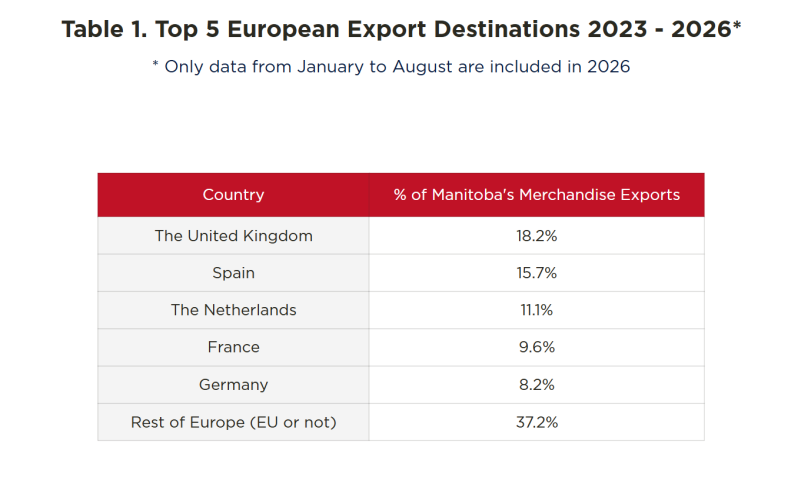
Between 2023--August 2026 4.1 per cent of Manitoba’s exports went to European countries, not just European Union members. In descending order, Manitoba’s top five customers were the U.K., Spain, the Netherlands, France and Germany (with an honourable mention to Italy for being a close 6th). Together these five countries purchased 62.8 per cent of Manitoba’s exports sent to Europe (see table 1).
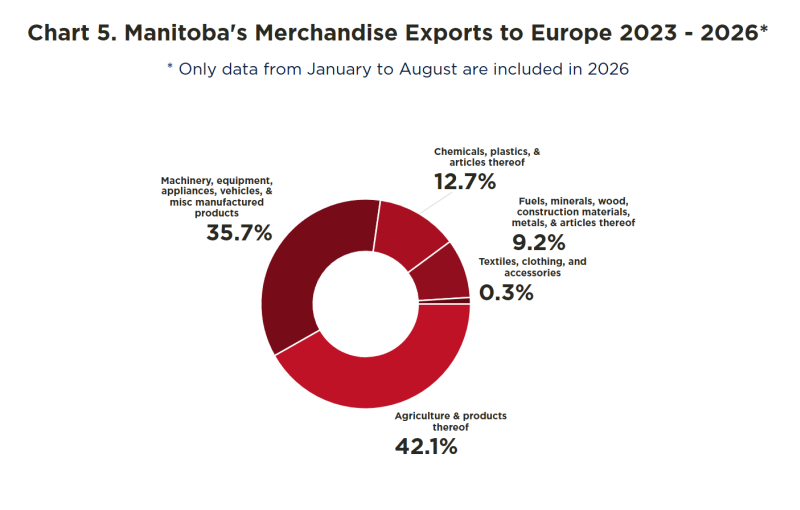
Trade with Europe is dominated by agricultural and manufactured products, which account for comparable shares of total exports (see chart 5). Upstream products lag behind these other two categories, while textiles, clothing and accessories account for a miniscule share of exports. The prominence of manufacturing products in Manitoba’s export basket to Europe indicates that our industries are interlinked. This is encouraging since expanding trade within that industry is easier than establishing a foothold; it is one of the key industries that Manitoba desperately needs to diversify its trade in; and Europe is precisely the type of trade partner Manitoba is looking for.
Though the growth potential for Europe is limited compared to other regions, it compensates for that potential in economic size. According to recent International Monetary Fund estimates, Europe and the U.S. have nearly identical GDP in 2026. The EU bloc itself is roughly 71 per cent of the size of the U.S. and Canada has a trade deal with that group of countries.
Suffice to say, the European pie is quite large and Manitoba wants a larger piece. There is room to compete for a share of the European market. Looking at what the U.S. exported to Europe in 2024 offers a sense of what these countries are purchasing. With the recent trade tensions under the Trump administration, Canada's appeal as a stable reliable trading partner has improved markedly.
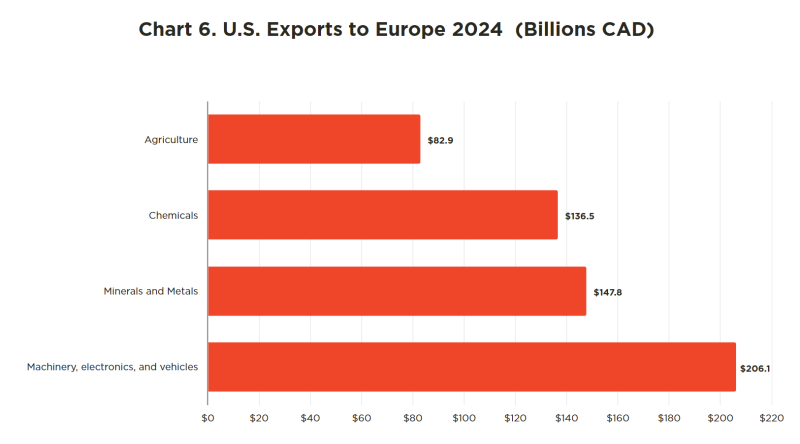
In 2024 alone, U.S. agricultural exports to Europe exceeded the value of Manitoba’s total exports worldwide between 2023 – August 2026 (see chart 6). For chemicals, raw and fabricated materials, and manufactured products, a single year of U.S. exports is nearly or more than double our total exports over the past three and a half years. Manitoba’s pharmaceuticals (chemicals), critical minerals, potash and, in the long run, the manufacturing products are all well-poised to reorient towards Europe and increase trade across the continent.
It also works in our favour that the U.S. has become increasingly disinterested in the North Atlantic Treaty Organization (NATO). NATO members have agreed to increase their direct and indirect defense spending to 5 per cent of GDP by 2035. The recent multilateral agreement between Canada and Thyssenkrupp Marine Systems (TKMS) to build a fleet of submarines is an example of the potential defense contracts to come. If Canada rethinks their agreement to only buy U.S. F35 jets and purchases SAAB Gripens as well, some production will occur in Canada and/or parts will be shipped to and from Europe. This would bode very well for Manitoba’s established aerospace industry.
Around the world
Beyond Europe, Manitoba can further develop its trade ties with other regions. It would be wise to hedge our diversification strategy: we do not want to trade dependency on the U.S. for dependency on a region of the same size—no matter how healthy relations presently are.
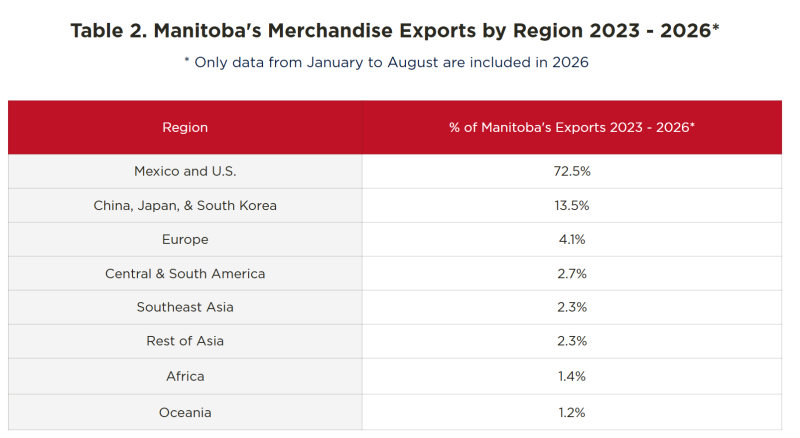
Table 2 shows the regional distribution of Manitoba’s exports between 2023 – present. As it stands, Canada has 15 Free Trade Agreements (FTAs) that open up access to 51 countries. There is talk of a Canada-Australia-New Zealand-UK (CANZUK) trade deal that would increase access and trade to Oceania — though this agreement is likely years away from materializing. The existing Comprehensive and Progressive Agreement for Trans-Pacific Partnership gives Canada access to 10 markets in Asia, Oceania, and the Americas. Businesses can make greater use of this agreement in the present and it may be enhanced in the future.
In October 2025, Canada reopened negotiations with the Mercosur bloc of South American nations. This agreement has serious potential to increase trade between Manitoba and South America. Across the Atlantic, a trade deal with a bloc of African nations, such as partial or complete access to the African Continental Free Trade Area (ACFTA), is not expected until well into the future. Individual trade deals with fast growing west-African nations like Nigeria, Ghana, and Côte d'Ivoire, each of which are accessible through trans-Atlantic trade, might be a more achievable goal for now. So too would individual trade deals with countries not fully covered by Mercosur (Chile, Colombia, Ecuador or Peru).
The Port of Churchill could expand Manitoba and Western Canada’s access to markets in Europe, Africa and South America. There is still much work to be done on the Port of Churchill Plus project. According to Arctic Gateway Group, the upgrades to the project would cost no more than $3 billion. Upgrades to the Port of Churchill and the railway would complement the recent improvements made to CentrePort Canada—which is the country’s largest trimodal inland port, one of the largest in North America, and is connected to pan-North American Class 1 railways. Despite the small price tag, it has yet to receive official status as a project of national interest by the federal government. Though it was listed amongst the 167 projects featured at the Canada Investment Summit in Toronto this past September. There are concerns about the direct economic benefits being insufficient to warrant the cost, the environmental impact of increased shipping activity on the wildlife in the area (beluga whales and polar bears), and its limited capacity compared to the Ports of Vancouver and Montreal. Valid as these criticisms are, they do not take into account the positive externalities that would be generated by completing the Port of Churchill Plus project.
Chief among the positive externalities is diversifying our trade partners, which is of national interest. Reduced dependence on the U.S. is a benefit in itself and should be considered along with the dollar value of goods and economic activity associated with the port and rail line. That diversification means that landlocked Alberta and Saskatchewan would have easier access to Atlantic trade, as well as B.C. to a lesser extent. This project would also strengthen Arctic sovereignty by supporting military operations and commerce. Both activities would contribute to economic development in Manitoba’s north and also the east coast of mainland Nunavut (the hamlets of Rankin Inlet and Arviat).
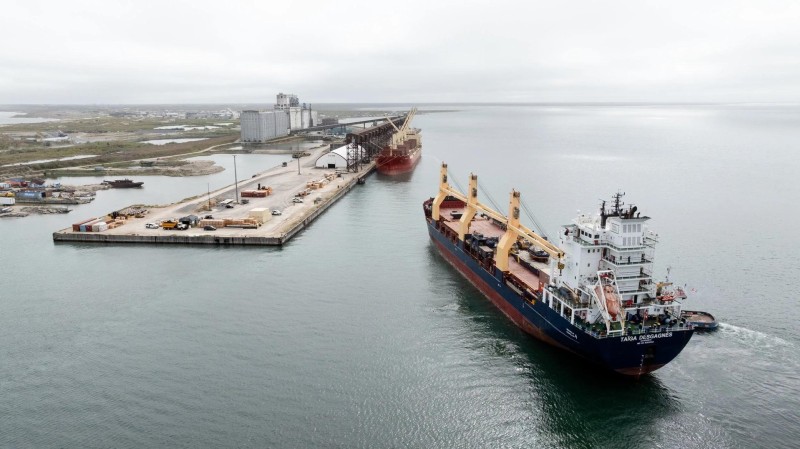 Before the end of this year, the Port of Churchill will complete shipments of grain, zinc and potash to Europe. It will take an estimated 10 days to ship from Churchill to Antwerp, which is three to four days shorter than the average time it takes to ship from Thunder Bay, Ontario. An agreement has been signed between representatives of the Port of Churchill and Port of Rotterdam to increase trade in critical minerals and other products. In addition, a recent study has been published showing that the Port of Churchill can be open year-round to ice class vessels without the support of icebreaking vessels. This year’s progress is demonstrable proof that the Port of Churchill Plus can contribute to the multi-year plan to diversify Canada’s export markets.
Finally, service exports offer another channel for Manitoba and Canada to diversify our trade. These exports include consulting in fields like engineering, accounting, marketing, information and communication technology services (ICT), and financial services. According to a recent report by Global Affairs Canada, services exports now account for nearly one-quarter of Canada’s total exports and the U.S. accounts for just over 50 per cent of these exports (much smaller than its 70 per cent share of merchandise exports). Manitoba in particular can benefit from this because services are less constrained by geography and the ICT industry in Winnipeg is robust.
Roll up the sleeves
Finding new markets for merchandise and services exports will take years, possibly a decade or more. As a major interprovincial trade, Manitoba is well positioned to benefit from other provinces diversification as much as its own. The national diversification effort will require coordination among governments, businesses and civil society. Infrastructure, including the Port of Churchill Plus, will need to be built or upgraded, and trade agreements negotiated, ratified or expanded. Businesses need to expand their domestic and international networks and supply chains, while widening their capabilities through investments in capital, research and development, and upskilling labour. Daunting as it may be, this is what it will take for Manitoba, and the rest of Canada, to diversify our trade partners. Off we go, heel for heel and toe for toe.
