
Introduction
The review of Canada-United States-Mexico Agreement (CUSMA) this summer is not a hard deadline. Rather, July 1 is a target date for the process to begin. Nor is the review of the agreement fundamentally adversarial. Reviews are in place because the North America Free Trade Agreement (NAFTA) was never amended between its signing in 1993 and replacement in 2018, despite all the transformations to the continental economy over the preceding quarter century. For example, several new industries pertaining to the Internet were not conceivable in 1993, and therefore not directly covered by NAFTA. Thus, a cordial review of CUSMA can be seen as beneficial to help keep the agreement current to industry needs. As another example, consider how much AI has advanced over the past eight years, let alone what its impact on the global economy will be by the mid-2030s.
 Unfortunately for Canada and Mexico, the other signatory to CUSMA has engaged in coercive behaviour through tariffs and rhetoric leading up to this review. While neither the U.S.-imposed Section 232 tariffs on Canadian metals, auto parts, vehicles, lumber and wood products nor the section 301 investigation of Canadian imports are technically a part of the CUSMA review, both these actions demonstrates the type of trade negotiations being put forward by the U.S. administration. All of this has put substantial pressure on the three countries and completely upended the upcoming negotiations. This digest will provide an overview of the CUSMA review and details on Manitoba’s merchandise trade with the U.S. between 2023-25.
Time to talk
This year’s CUSMA review can take many directions. The most likely outcomes of the negotiations are: an inconclusive review and all parties agree to meet next year; modest to substantial revisions that favour the U.S.; or CUSMA is abandoned in favour of bilateral deals.
There are arguments in favour of bunkering down and waiting for a future where the U.S. sends a new, more favourable negotiation team to the table. Alternatively, there are arguments in favour of making concessions now for the sake of certainty and economic stability. Few are seriously arguing that CUSMA should be eliminated. If it were, the agreement would remain in place for six months and then the countries would fall back onto the World Trade Organization most-favoured-nation trade rules until the bilateral deals are reached. In this worst-case scenario, Canada would experience a significant recession once the CUSMA shield is lifted and all the products it once covered are tariffed.
Scotiabank Economics estimates that, compared to a scenario with minor revisions to CUSMA, abandoning the deal would reduce Canada’s real GDP by as much as two per cent in 2027, with a very slow recovery process starting later that year or early in 2028.
Desjardins Economics also predicts a severe recession in 2027 if CUSMA were abandoned. Further, they estimate what the effective tariff rates would be with adverse revisions to CUSMA or abandonment of the agreement. Manitoba, thanks to its robust manufacturing sector, would have one of the highest effective tariff rates, in line with Ontario, Quebec and Nova Scotia. Meanwhile, energy-intensive Alberta and Saskatchewan are predicted to have lower effective tariff rates (presuming oil and gas is prioritized).
The big-ticket items the U.S. wants from Canada include:
- Another increase to the regional value content (RVC) requirement for vehicles, light or heavy trucks and their parts produced in North America.
- Opening up our dairy and eggs supply management system to more U.S. imports.
- Changing or removing the Online News Act, among other concessions relating to digital services (forgoing the potential social media ban for youth and/or AI policy).
- Alignment on continental security (notably, relations with China).
- Access to critical and rare-earth minerals.
Individually, each of these concessions pose challenges. As a whole, they are highly problematic:
- The RVC requirement rose from 62.5 to 75 per cent for vehicles and light trucks, and 60 to 70 per cent for heavy trucks, when CUSMA was signed in 2018. Since then, the share of Canadian automotive exports deemed compliant fell from 94 per cent to 90 per cent because the costs of adjusting production to the new rules exceeded the non-compliance tariff rates. Another increase to the RVC may lower compliance rates further and increase production costs. The 70 per cent steel and aluminum RVC requirement is now moot thanks to the 50 per cent tariffs on Canadian metals, so an increase in that threshold would be strictly performative.
- Canada already scrapped its plans for a digital services tax and it stands to reason that repealing the Online News Act would lead to a decline in smaller, local news outlets, at the expense of larger organizations that have more bargaining power when negotiating with digital platforms.
- Supply management is literally and figuratively a sacred cow in Canada. As we will show in the next section, Canada and Manitoba are net importers of U.S. dairy and eggs. Importing even more of these products from the U.S. could threaten the margins of Canadian and Manitoba farmers, especially the small and medium sized farms, and pose a threat to food safety.
- International relations with China have been shaky (the tariffs on Canadian pork are still in place), but the canola tariffs were significantly reduced earlier this year in exchange for allowing more Chinese electric vehicles into Canada. If the U.S. insists on Canada taking a harder stance on engagement with China, it may reintroduce tariffs on Canadian products and that would have an adverse effect on exports.
- An agreement on access to minerals is not contentious. However, if the terms are at the expense of Canada’s ability to trade in these minerals with other countries, it is then an issue of trade sovereignty.
For Manitoba, serious concessions on the RVC requirement, supply management and security alignment would heavily and immediately impact manufacturing and agriculture. Mining concessions would be felt further down the road, as would changes to digital services. Another item with implications for Manitoba is the labelling of meat in the U.S. Currently, products are not required to be labelled by country of origin. Should those rules change, that could lower demand for Manitoba exports of pork and other meats.
Canada does have explicit and implicit leverage in these negotiations (as does Mexico). Forbes has argued that the trade volume should not be confused for substitutability. When it comes to the automotive industry, the U.S. cannot quickly or cheaply replace its trade with Canada and Mexico. Nor can they find new sources of energy products, potash from Saskatchewan, nor the critical and rare earth minerals that can be mined across Canada (including Manitoba). These products carry substantial weight at the bargaining table. In the case of energy and fertilizer, prices respond rapidly to supply disruptions, and this will be felt by U.S. households very quickly. Likewise, Canadians decisions to opt for different travel destinations and alcohol this past year had an outsized effect on U.S. commerce in select regions. The border towns, snowbird destinations, vineyards and distilleries (Kentucky bourbon) bore the brunt of the impact.
The implicit leverage comes in several forms. Tariffs are generally unpopular, and most Americans think CUSMA is good for their economy. The U.S. Supreme Court’s ruling against IEEPA tariffs has limited the Administration’s ability to use tariffs as a bludgeoning tool. The conflict with Iran has led to an increase in the price of oil and the price of fertilizer. The Democrats are presently predicted to win November’s midterm elections, and a lack of progress on a CUSMA deal this summer will not help Republicans’ electoral fortunes. These different forces interact with each other and provide less room for the Americans to aggressively bargain for severe concessions from Canada and Mexico.
Bacon for eggs?
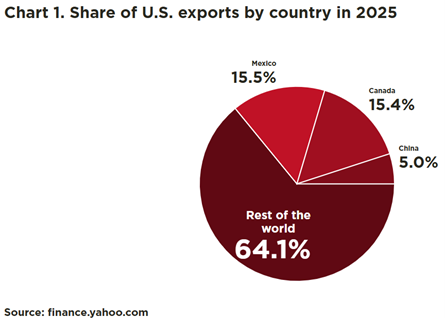 Though Mexico and Canada are more dependent on the U.S. than vice versa, they are still that country's top trading partners. In 2025 Mexico surpassed Canada to be the top destination for U.S. exports, accounting for 15.5 per cent of the total (down from 16.2 per cent in 2024). Canada was right on their heels, buying 15.4 per cent of all U.S. exports in 2025, down from 17 per cent in 2024 (see chart 1). The next largest importer of U.S. goods is China, which bought five per cent in 2025. On their own, Canada and Mexico stand head and shoulders above other countries when it comes to purchasing U.S. exports. Together they account for nearly one third of all exports purchased and are still considered political allies despite the turbulence of this past year. Furthermore, the U.S. tends to run a trade surplus with Canada, exporting more than it imports, after energy (mostly oil and gas) is removed from the equation. As for Manitoba, the U.S. runs a persistent trade surplus with our province — including or excluding energy.
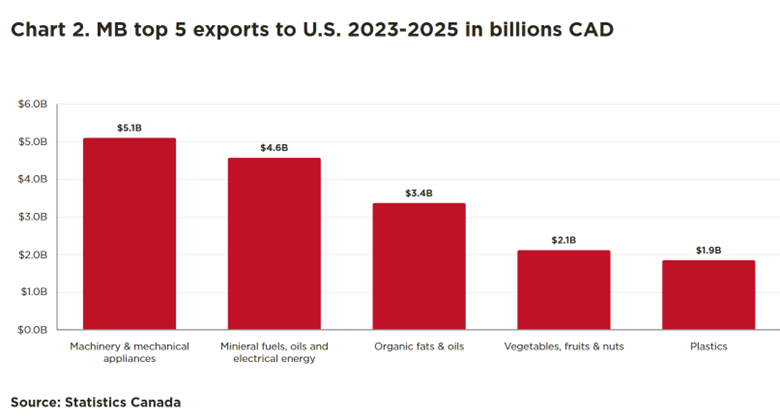
Statistics Canada uses the Harmonized System (HS) to classify products that are exported or imported by Canada. In charts 2 and 3 we show the top 5 imports or exports out of 99 different categories. These top exports include goods from the manufacturing, energy and agricultural sectors. Pharmaceuticals are also a top export, but we exclude them from the analysis because the trade data is under review. For exports and imports, the top 5 products account for 49.5 per cent and 56.2 per cent of trade with the U.S.
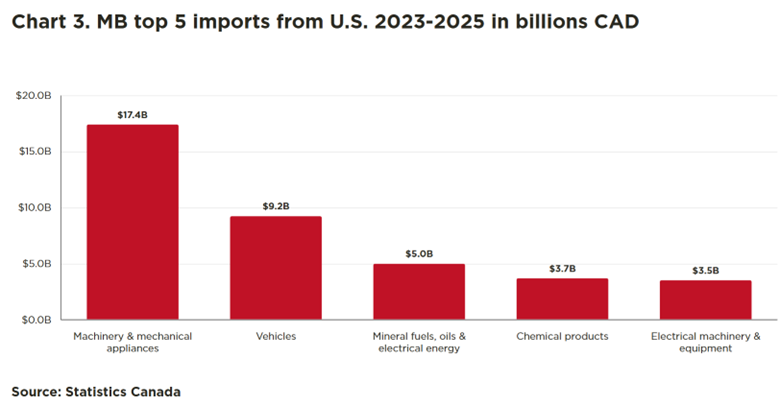
These charts illustrate two points. First, Manitoba is heavily integrated with the North American supply chain, similarly to Ontario and Quebec. Second, the U.S. is no more likely than Manitoba to find new trading partners to buy its machinery, mechanical appliances and vehicles if it chooses to walk away from CUSMA this summer. Each year Manitoba buys over $5 billion CAD in machinery and mechanical appliances alone. That sort of customer is not easily replaced.
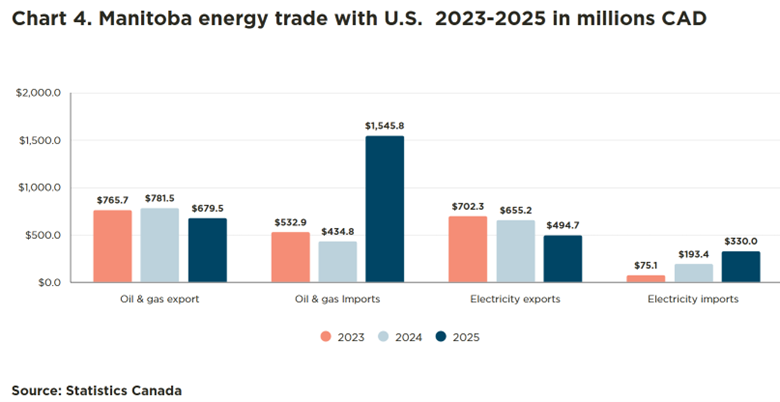
Chart 4 separates trade in oil and gas from hydroelectric energy. As discussed in the previous digest, 2025 was an outlier for energy imports and exports. Oil and gas imports more than tripled in 2025 compared to 2024, and electricity imports rose by 170.6 per cent between 2024 and 2025. The latter is due to the drought last summer, which also explains why exports of electricity dipped below $500 million in 2025, from over $655 million the year prior. Energy is a key area where the effects of tariffs or in an extreme case, an embargo, would be felt immediately by U.S. households. Thus, it is considered a major bargaining chip at the CUSMA negotiation table, and Manitoba is contributing to Canada’s leverage.
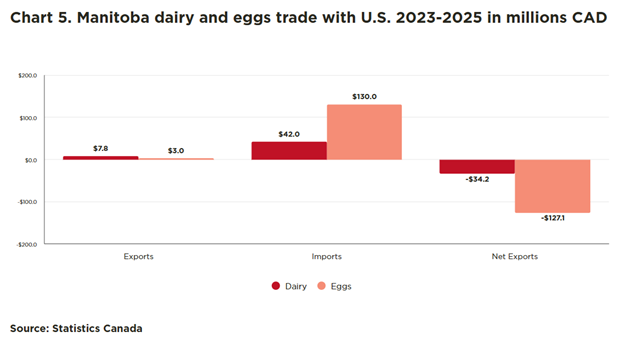
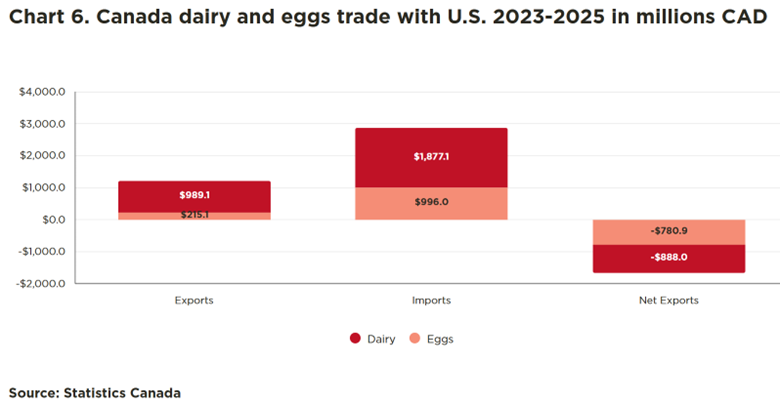
Much like the complaints of trade deficits and offshoring manufacturing jobs, the opposition to our supply management system is a matter of principle (or pride?), not economics. Chart 5 displays Manitoba’s exports, imports and net exports of dairy and eggs with the U.S. between 2023 and 2025. Manitoba purchases substantially more dairy and eggs from the U.S. than it sells. The same is true of Canada as a whole (see chart 6). In addition, the supply management system in Canada, which comprises numerous small- and medium-sized farms, helped to minimize the impact of the bird influenza outbreak in 2024. These smaller and medium farms are disconnected from each other which helped to slow the spread of the virus. In contrast, the U.S. is more dependent on mega-farms that, once contaminated, had a much larger impact on the supply chain.
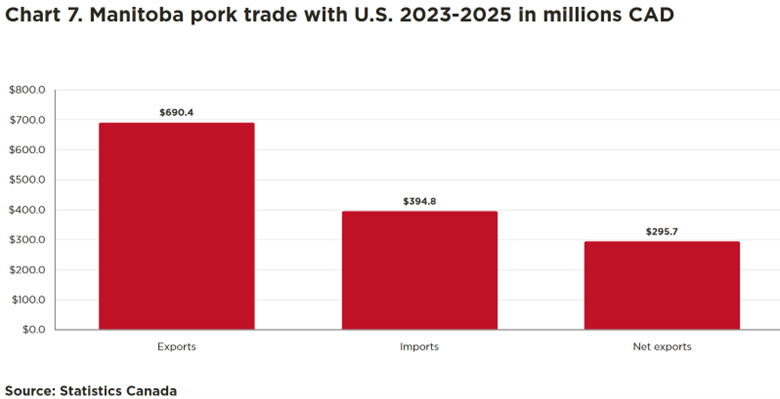
Related to dairy and eggs, Manitoba is a net exporter of pork to the U.S., sending $690.4 million and buying $394.8 million between 2023 and 2025 (see chart 7). Such is the essence of fair trade: Manitoba is very good at producing pork, so the U.S. decides to buy it. Then, in exchange, the U.S. fills the dairy and eggs supply deficit when domestic production is at capacity. Oink.
Canadians expressed their disapproval of the trade war, and 51st state rhetoric, by substituting travel to the U.S. for another country (or province). For the record, Canadians were the top visitors to the U.S. in 2024 (Mexicans were number two). In 2025, the number of Canadians flying to anywhere in Canada from the U.S. dropped by 25.4 per cent compared to the year prior. Fewer Americans visited Canada in 2025 compared to the year earlier, but that decline was much smaller (4.7 per cent). Statistics Canada provides data on entry into Canada by air and vehicle for internationals and citizens.
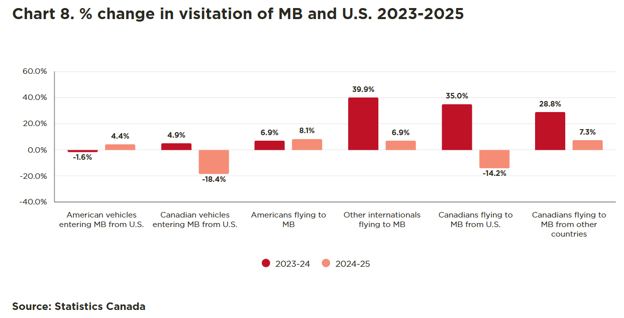
Chart 8 displays how travel habits of Americans, Canadians and other international visitors changed between 2023 and 2025. Working from left to right, we can see that the number of American vehicles entering Manitoba from the U.S. increased in 2025 compared to the year prior. In contrast, the number of Canadian vehicles entering Manitoba from the U.S. declined by 18.4 per cent between 2024 and 2025. The same pattern held for flights from the U.S. to Manitoba. More Americans flew to Manitoba in 2025 than 2024, but the number of Canadians flying to Manitoba from the U.S. declined by 14.2 per cent.
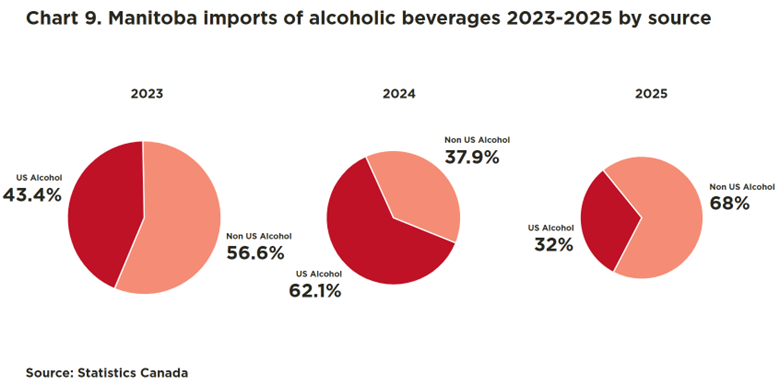
The decision by many provinces to remove U.S. alcohol from their shelves was felt by U.S. producers. As of 2022, Canada was the top importer of alcohol (Mexico was number 5). In 2023 and 2024, the U.S. accounted for 43.4 per cent and 62.1 per cent of all alcoholic beverages imported by Manitoba. In 2025, imports plummeted and the U.S. accounted for 32 per cent of the total (see chart 9). In December, Manitoba put American products back on the shelf (wine is Manitoba’s favourite), but many consumers may have developed new tastes as they experimented with other foreign or domestic brands. The same can be said about travel. New CUSMA or old, many Canadians will remain unhappy with their southern neighbours for years to come.
Where do we go from here?
The economic integration between Canada, Mexico and the U.S. cannot be undone over night. We established that Manitoba plays a significant role in the North American manufacturing, agriculture and energy industries; the complaints around Canada’s supply management system are unfounded; and Manitobans kept their elbows up in 2025 by travelling less to the U.S. and not purchasing American alcohol. Those consumer choices did have a significant impact on the U.S. and contribute to the leverage we bring to the bargaining table. The talks will be challenging, and Canada will have to lean heavily on its key advantages in energy, potash and critical minerals.
A bad deal with the U.S. should be avoided. The short- and long-term implications for the Canadian and Manitoban economy would be profound. If serious concessions are made, it is possible a future U.S. administration would undo these changes six years from now during the next round of revisions. This is a risky and costly option, there is no guarantee that CUSMA will be reverted to its 2018 version, and six years of concessions would have a sizable impact on our economy. Deferring talks into the future also depends on the next administration being more trade friendly, but these negotiations would be from a position of the status quo and not an inferior agreement. During the interim, Canada would not be impacted by concessions, instead we would be dealing with more of the same uncertainty for three or four years. Perhaps we should take Shakespeare’s advice and bear the ills we have, than fly to those we know not of.
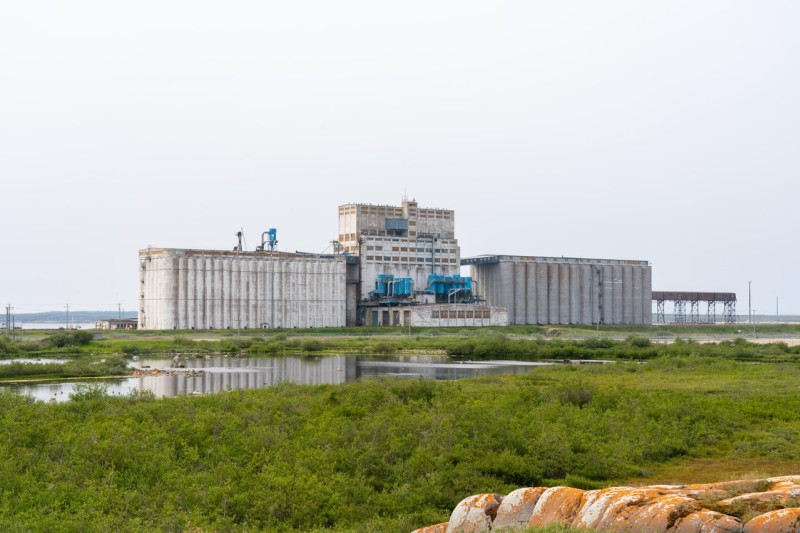 Regardless of the deal, Canada and Manitoba must continue to diversify their economies to open up new trade opportunities with new partners. This will take time, but there is plenty of potential. TD Economics reported that Canada increased its trade with other countries in 2025, with the largest gains made in oil and precious metals. The manufacturing, steel and aluminum industries saw modest improvements. This is not to be discouraged. Canada and Manitoba have the resources, technology, productive capacity and workforce required to reorient the economy towards new products and partners. The Port of Churchill will play a key role in this future. So, too, will Manitoba’s critical and rare earth minerals. These are an important export, which can also help support domestic production of EV batteries and/or EV vehicles.
Two things we know for certain about the CUSMA review talks this summer: anything can happen and there will be a follow up Digest later this year on the subject. To be continued.
